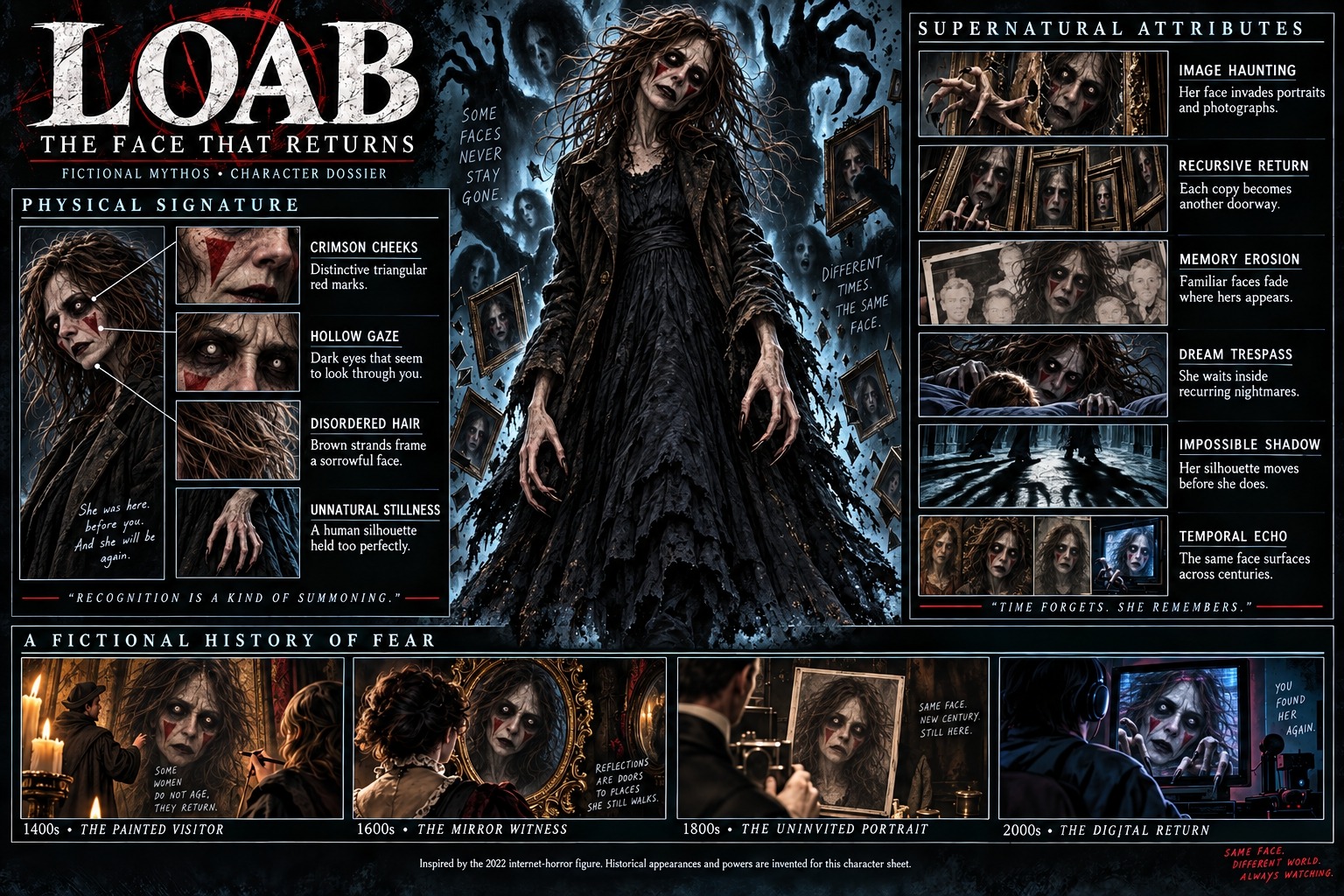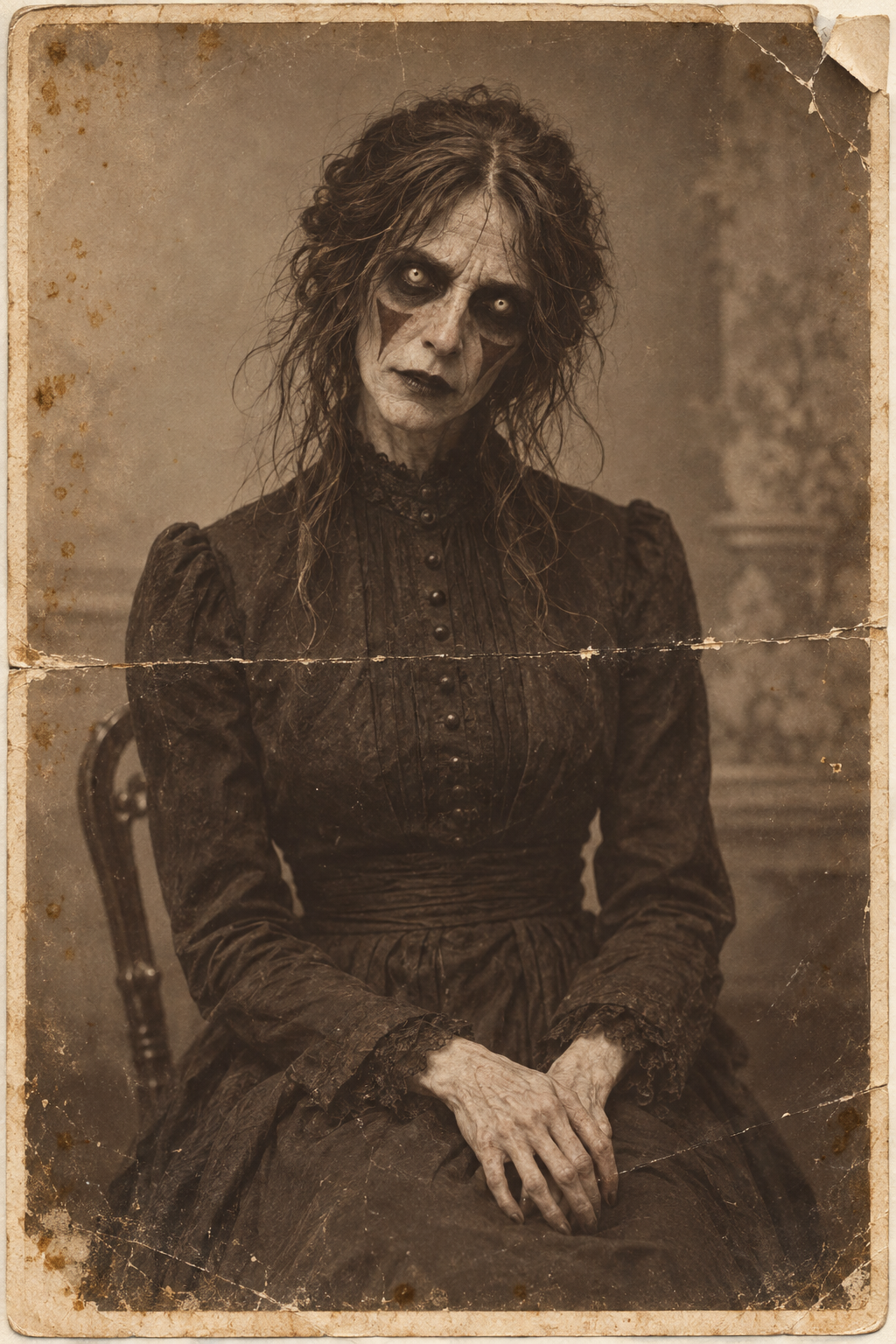
The legend
The Last Portrait
Before they called her Loab, she painted the dead.
In the winter of 1461, families brought their children to her cottage wrapped in blankets. She painted them as they had been: warm cheeks, bright eyes, mouths almost smiling.
She never charged for the little ones.
Her own daughter, Mara, died in February.
Loab painted her eleven times. Every portrait was perfect except for the eyes. She could remember their color, but not how they had looked at her.
On the twelfth night, something spoke from behind the canvas.
“Let me look through yours.”
Loab bent close.
In the morning, the painted child had her daughter’s eyes.
Loab had two red marks beneath her own.
For three days, she heard Mara moving about the cottage. Small footsteps. A chair dragged toward a cupboard. Once, a sleepy voice asking for water.
She left a cup beside the portrait.
By dawn it was empty.
Then the families began returning.
Their painted children had changed. Some now stood in unfamiliar rooms. Others had turned their heads toward something outside the frame.
One mother brought a portrait wrapped in three sheets.
“That woman behind him,” she said. “Who is she?”
Loab unwound the cloth.
Her own face looked out over the boy’s shoulder.
The painted boy was trying to get away from her.
That evening, Loab cut open Mara’s canvas.
Behind it was another painting: her daughter huddled beneath a table, holding both hands over her mouth.
Farther back, in a doorway, stood a woman wearing Loab’s dress.
Her face was unfinished.
The villagers found Loab sewing her eyelids shut.
She told them something was learning her.
They boarded her inside the cottage and burned it before sunset.
Through the flames, they heard a woman begging them to stop.
Then they heard every dead child in the village begging with her.
They opened the ruins three days later.
Loab’s body sat upright before her easel. Her eyelids were still sewn closed. Beneath the stitches, something had pressed outward hard enough to split the thread.
The portrait was untouched.
It showed the cottage burning, the villagers watching, and Loab standing among them.
Everyone remembered the woman beside them.
Nobody remembered letting go of her hand.
Centuries later, a museum photographed the surviving portrait.
The technician noticed a small discrepancy.
In the original, Loab stood at the edge of the crowd.
In the photograph, she stood closer.
He took another.
Closer.
He deleted both images and turned off the camera.
Its screen lit again.
This photograph showed the back of his head.
He remained very still.
Behind him, a woman drew a slow, difficult breath, as though remembering how lungs worked.
Then she spoke in his mother’s voice.
“Let me see if I have your eyes right.”